


Engine: LS1
Part of the GM LS (Gen III / IV) family.
Modeled power and torque
Modelled estimate, not a dyno result.
Modeled estimate, not a dyno measurement. Real results vary with fuel, weather, dyno type and build.
Stock is anchored to the factory rating (345 hp at 5600 rpm, 350 lb-ft at 4400 rpm); the curve shape between peaks is modeled. Intake + exhaust + tune (pump fuel): Typical NA gains come mostly above mid-rpm.
LS1 data
- Load sensing
- MAF+MAP (blended / torque model)
- O2 sensor
- Not yet sourced
- Closed loop
- Not yet sourced
- Block
- aluminium
- Rods / pistons
- sintered-forged (powder-forged) PF1159M steel, fracture-split (cracked) big end · hypereutectic, flat-top
- Reported limit
- forged rods/pistons recommended beyond ~550 hp; some report ~600 hp on stock internals with no reliability guarantee (8020automotive guide)
- Factory
- LS1 tall injector, EV1 (Jetronic) connector · 315 cc/min
- Impedance
- high (saturated)
- Direct-fit upgrades
- 5 maker-listed
- Knock
- GM 12589867 (repl 10456603); MM notes possible supersession to 12601822
- MAP / MAF
- GM 19418807 (repl 12614970, 16212460)
- O2 (upstream)
- GM 19178930 (Corvette 1997-2003) | GM 19355308 (Camaro 1998-2002, position not stated) | GM 12569429 (Corvette 2004 front)
Platform background
The C5 Corvette (1997-2004) and the fourth-generation Camaro/Firebird with the LS1 (1998-2002) introduced the Gen III LS. Both use a 24x crank / 1x cam trigger and a single Gen III PCM that runs the engine and the 4L60-E automatic. The C5 was GM's first drive-by-wire Corvette and uses a separate throttle actuator control (TAC) module; the F-body uses a cable throttle. The C5 Z06 added the LS6 from 2001.
Factory ECU
LS1 (all) and LS6 (2001-04 Z06): Gen III, 24x crank, 1x cam sensor at rear of block
Sourced863- 1997-98 PCM is a different type
- 1999 is the same type as 2000-on but with some pinout differences
- The '411' PCM is standard from 2000
- 411-type PCM uses red and blue connectors
- The later '242' truck PCM uses green and blue
- Drive-by-wire from 1997 via an all-plastic TAC module paired with the PCM over a serial link
- Throttle body unchanged through C5 production
- Cable throttle
- An F-body PCM is not set up for the C5 TAC serial data
Gen III PCM controls engine and 4L60-E transmission in a single module
Sourced · medium8Use a matched set: a C5 needs a PCM calibrated for drive-by-wire and the matching early TAC module. An F-body runs a cable-throttle calibration with an idle air control valve. The PCM operating system and calibration, not just the hardware, decide which throttle type it supports.
Factory ECU pinout: pending
No OEM pin table is in our library yet for the LS1 factory ECU. No OEM-grade public pinout was found. Needed: the GM service manual Engine Controls / Wiring Systems section for this vehicle and year, giving the PCM/ECM connector end views and terminal tables. Specifically the 1997-2004 Corvette and 1998-2002 Camaro/Firebird service manuals, PCM connectors C1/C2 (blue/red on 411-type units). Until then, wire from the harness maker's instructions or the factory service manual.
Factory ECU pinout
No OEM-grade public pinout was found. Needed: the GM service manual Engine Controls / Wiring Systems section for this vehicle and year, giving the PCM/ECM connector end views and terminal tables. Specifically the 1997-2004 Corvette and 1998-2002 Camaro/Firebird service manuals, PCM connectors C1/C2 (blue/red on 411-type units).
Harness: wire-in
No plug-and-play harness for the S3 pinout is listed for this vehicle yet. The route is a universal wire-in harness: the factory ECU is removed and each circuit is wired to the new ECU from a pinout. Nothing is written to the factory ECU.
Being researched
We're mapping S3 plug-in and factory-connector adapter harnesses to this application.
Universal flying lead or re-terminated factory harness
Always available: terminate the engine side to ECU2's two Superseal 34 connectors. Universal harness from $405 USD list.
Your GAINS system for this car · pre-release
ECU2 for the Firebird / Trans Am 4th gen
Planned with the same rules as the configurator for this car's 8 cyl · port injection · cable or drive-by-wire. The factory ECU is unplugged and replaced; nothing is written to it.

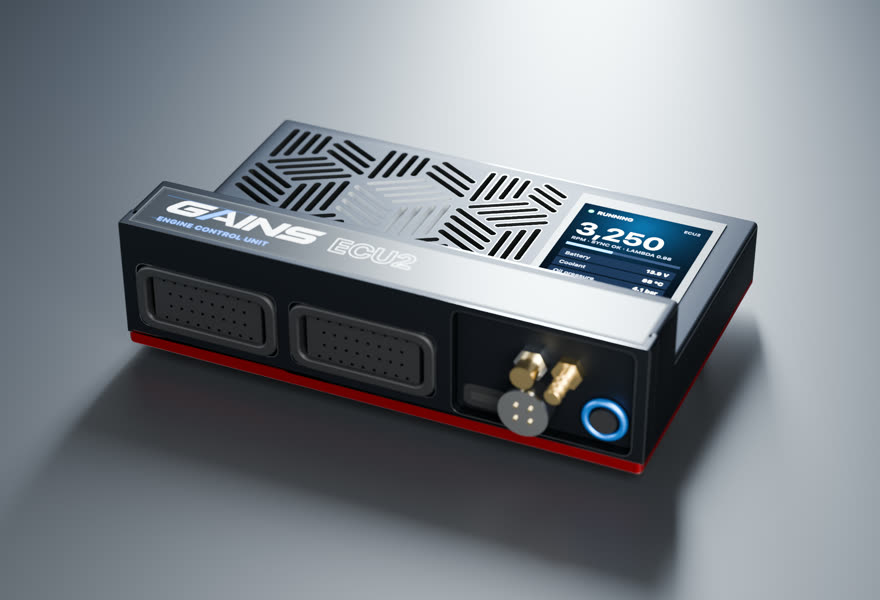
- Price TBA
ECU2Engine controller
8 cyl · port injection · cable or drive-by-wire
Full sequential fuel and spark for this 8-cylinder on a cable throttle, with the wideband built in.
in designEst. availability: April 2027
Add PDM2 to switch and protect chassis loads (pumps, fans, lights, accessories). Add it in the configurator →
Track days? Add the Telemetry Dongle Pro for 25 Hz GPS lap timing; it plugs into the OBD-II port, and your phone is the dash. Plan it in the configurator →
What you get
- A screen on the ECUA 2.4-inch, 500-nit display in the lid, readable in a footwell.
- Faults in plain words"Coolant temp sensor open circuit.
- S3-style harnessesConnector A and C pin functions follow the published Nexus S3 wiring diagram.
- Powered CAN portA sealed 4-pin port on the insert carries 12 V and CAN for the PDM2 and GAINS displays: one cable per accessory.
- GAINS insideThe on-ECU adaptive layer, the app, logging and your limits.
How it wires in
- Haltech S3 plug-in harnessNone listed for this car
- Factory-connector → S3 adapterNone listed for this car
- Wire-inYour route: universal wire-in harness
Pin-compatible per the published S3 pinout, not yet fit-tested. Every harness option for this car ↓
ECU2 is in design; specifications may change. All GAINS hardware is pre-release concept design; nothing is for sale yet and no application is validated on a vehicle. Harness fitment is from published pinouts and not yet fit-tested.
Swap guides
The LS1 family in other cars
How GAINS approaches the Firebird / Trans Am 4th gen
Our starting method for this engine, as foundations first: get it running and drivable, then learn fuel, then the hardware-specific strategies. It is a methodology outline, not a validated calibration.
- 1Base map and first startplanned
Start from displacement, injector data and the sensors fitted, then let the first-start learner settle cranking, idle and warm-up before any load work. The goal is a safe, running engine, not a finished calibration.
- 2Lambda targets and VE learningclosed loop on GAINS ECUs
Air-fuel targets come from your goal (street, track, economy). The ECU then learns its fuel table cell by cell from the onboard wideband inside a signed envelope, and you approve promoting what it learned into the base map.
- 3Drivability foundationsplanned
Pedal map, tip-in and decel fuel, idle control, cold start and warm-up enrichment: the tables tuners spend hours on after the main map. Each is a strategy in the knowledge engine with its own limits.
- 4Factory load sensingfactory reference
What the factory ECU measures load with: MAF+MAP (blended / torque model) (low confidence)
- 5Wideband sensorhardware
factory O2 type not yet sourced; plan on a Bosch LSU 4.9 for the GAINS ECU's built-in controller
- 6Bottom end and head sealingfactory reference
Reported: Stock rods and cast pistons are the commonly cited weak points under boost. One guide puts the crank at about 800 hp. EngineLabs notes cast-piston ring lands and stock head bolts as concerns, and builders gap the rings or fit head studs. (medium confidence) Limits depend on tune quality, fuel, rpm and condition and are not guaranteed.
Drivetrain
Because the C5 automatic bolts to the rear differential housing, the PCM's transmission calibration is specific to the transaxle. Do not assume an F-body 4L60-E calibration carries over.
Chassis integration
When fitting a standalone controller, budget for the cluster, ABS/traction and A/C, which depend on PCM messages. Retaining the factory PCM is usually simpler on street cars.
Tuning notes
Most modified LS1/LS6 cars hit injector and MAF limits after cam, heads and headers. Start by checking injector duty and MAF frequency against the calibration's maximum, then tune VE and MAF together and confirm spark with knock logging. For a 58x Gen IV engine in these chassis, the usual route is a Gen III PCM plus a 58x-to-24x conversion module.
Popular swaps
GAINS on the Firebird / Trans Am 4th gen
ECU2
Designed so your phone is the laptop, keypad and dash
The GAINS app is designed to handle tuning, logging, gauges and switch inputs over Bluetooth, so the system needs no separate CAN keypad or display. Keypad, dash and logging views are planned; the iOS prototype runs on simulated data today.
Wideband, IMU and logging built in
An onboard Bosch LSU 4.9 wideband controller, a 6-axis IMU and onboard logging are designed into the ECU rather than sold as add-on modules.
Modular, so you buy what the engine needs
This engine runs on ECU2. PDM2 (power, body and gearbox) is optional and connects over ECU2's powered CAN port; the Telemetry Dongle Pro adds GPS lap timing from the OBD-II port.
Calibration that keeps learning
Instead of a fixed map that drifts as parts and conditions change, the ECU keeps adapting its fuel trims within limits you can see and approve in the app.
Adaptive tuning strategies
- VE learning closed loop on GAINS ECUs
Learns the fuel table from the onboard wideband as you drive, cell by cell, inside a signed authority envelope. Learned trims are promoted into the base map without a step in fuelling.
- Goal-based lambda targets closed loop on GAINS ECUs
Sets air-fuel targets from your goal (economy, response, power, safety margin) instead of a single fixed table.
- Knock protection protection
Listens for knock on a dedicated knock processor, pulls timing at once and restores it slowly. It only ever reduces advance.
- Warm-up, cranking, idle and transient fuel planned
The same learning approach applied to the tables tuners spend hours on after the main map is done.
- Spark advance and boost authority gated
Widening ignition advance or boost is never automatic. It stays an expert or dyno decision until validated knock detection exists for the engine family.
Already running another ECU? In advisor mode the same strategies read your logs and recommend exact table changes with the reasoning, which you apply in your ECU vendor's own software.
GAINS hardware is pre-release concept design. Simulated results only; nothing is validated on a vehicle yet.
Frequently asked
What PCM does a C5 Corvette use?
A Gen III PCM: 1997-98 cars have an early type, 1999 is close to the later type, and 2000-on cars use the common '411' PCM with red and blue connectors, paired with a separate TAC module for drive-by-wire.57
Is the LS1 Camaro drive-by-wire?
No. 1998-2002 F-body LS1 cars use a cable throttle, while the C5 Corvette is drive-by-wire through a TAC module.47
Can I put an LS3 in a C5 Corvette?
Yes. A common approach keeps the 24x Gen III PCM and adds a 58x-to-24x conversion module to read the LS3's 58x crank and 4x cam signals.62
What is the redline of the LS6?
GM set the LS6 redline at 6,500 rpm, versus 6,000 rpm for the LS1.3
Sources
Numbered as cited above. Hover or tap a citation chip to preview it.
- The Complete C5 Corvette Buyer's Guide · AutoGuide · press · retrieved 2026-10-25
- Crank and Cam Timing Sensors: Reluctor Ring Selection for LS, LT, and Coyote Swaps · Billy's Speed Shop · vendor-doc · retrieved 2026-10-25
- GM Press Release: 2001 Corvette Performance · General Motors (via Corvette Action Center) · oem · retrieved 2026-10-25
- C5 PCM question (forum thread) · CorvetteForum · community · retrieved 2026-10-25
- LS Engine Controllers, Making Your LS-Power Change A Controlled Swap · Chevy Hardcore · press · retrieved 2026-10-25
- Dialing In LS Sensors For Various Generations With Michigan Motorsports · EngineLabs · press · retrieved 2026-10-25
- Navigating Gen-III LS Drive-By-Wire Throttle Bodies With PSI · LSX Magazine · press · retrieved 2026-10-25
- 24x vs 58x Reluctor Differences for LS and LT · PSI Conversion · vendor-doc · retrieved 2026-10-25
- Chevrolet Corvette (C5) · Wikipedia · community · retrieved 2026-10-25
Catalog data and evidence
- Catalog data, not yet expert-reviewed.
- No vehicle photos: illustrations only until licensed imagery is available.
- Factory ECU part numbers not yet sourced for this vehicle.
- E-900 Haltech Nexus S3 catalog (sourced, high confidence)
- E-941 S3 engine harness availability (inferred, medium confidence)