


Engine: Barra 4.0 NA
Part of the Ford Barra family.
Modeled power and torque
Modelled estimate, not a dyno result.
Modeled estimate, not a dyno measurement. Real results vary with fuel, weather, dyno type and build.
Stock is anchored to the factory rating (262 hp at 6000 rpm, 288 lb-ft at 3250 rpm); the curve shape between peaks is modeled. Intake + exhaust + tune (pump fuel): Typical NA gains come mostly above mid-rpm.
Barra 4.0 NA data
- Load sensing
- Not yet sourced
- O2 sensor
- Not yet sourced
- Closed loop
- Not yet sourced
- Block
- cast iron, aluminium head
- Rods / pistons
- E-Gas variant: stronger H-section rods
- Reported limit
- Not yet sourced
- Factory
- Not yet sourced
- Impedance
- Not yet sourced
- Direct-fit upgrades
- None listed yet
- Knock
- Bosch 2-pin knock sensor (Bosch number not captured)
- MAP / MAF
- Ford XS6F-9F479-AB
- O2 (upstream)
- Bosch 0 258 986 603 (marketplace listing, OE ref BA-9F472-A in listing URL)
Platform background
Australian-built Falcon sedans and utes (BA 2002-05, BF 2005-08, FG 2008-14, FG X 2014-16) and the SX/SY/SZ Territory share the Barra 4.0 inline six in NA, turbo and LPG forms. They use a Ford PCM that can be reflashed across the whole run. The main platform split for tuning and swaps is electrical: BA/BF PCMs can run without the rest of the vehicle network once PATS is disabled and a speed sensor is wired in, while FG/FG X PCMs need vehicle speed over CAN from the ABS or transmission controller. Driveline options include BTR four-speed and 5R55S five-speed automatics, the ZF 6HP26 six-speed automatic, and T5, T56 and TR-6060 manuals.
Factory ECU
- Ford powertrain control modulePCM
- Turbo versions read a boost pressure sensor
BA, BF, FG and FG X Falcon (2002-2017) and SX, SY, SY-II, SZ and SZ-II Territory petrol (2004-2017). ZF 6HP26 TCM editing is also available. EcoBoost Falcon and diesel Territory are not covered.
Sourced9Normally received over CAN from the ABS or TCM. Can be reconfigured to use a hard-wired output-shaft speed sensor.
Sourced · medium10CAN only, from an OEM TCM or ABS module. The speed-source setting is ignored, and without an ABS module the engine will not run correctly.
Sourced · medium10Ford PATS. On BA/BF it can be disabled in calibration for swaps, which disables BCM/ICC function.
Sourced · medium10On a complete car, reflashing the stock PCM is the normal route. Commercial tools give near-OEM access to the calibration, including flex-fuel, gear-based boost control and dual-map features. For swaps, choose the PCM generation for its network dependence: BA/BF can be made largely self-contained, while FG/FG X needs ABS or TCM messages or emulation.
Factory ECU pinout: pending
No OEM pin table is in our library yet for the Barra 4.0 NA factory ECU. Pinout pending an OEM-grade source: Ford Australia BA/BF/FG workshop manual, PCM connector pin tables. Until then, wire from the harness maker's instructions or the factory service manual.
Factory ECU pinout
Pinout pending an OEM-grade source: Ford Australia BA/BF/FG workshop manual, PCM connector pin tables.
Harness: wire-in
No plug-and-play harness for the S3 pinout is listed for this vehicle yet. The route is a universal wire-in harness: the factory ECU is removed and each circuit is wired to the new ECU from a pinout. Nothing is written to the factory ECU.
Being researched
We're mapping S3 plug-in and factory-connector adapter harnesses to this application.
Universal flying lead or re-terminated factory harness
Always available: terminate the engine side to ECU2's two Superseal 34 connectors. Universal harness from $405 USD list.
Your GAINS system for this car · pre-release
ECU2 for the Falcon / Territory BA-FG-X
Planned with the same rules as the configurator for this car's 6 cyl · port injection · drive-by-wire. The factory ECU is unplugged and replaced; nothing is written to it.

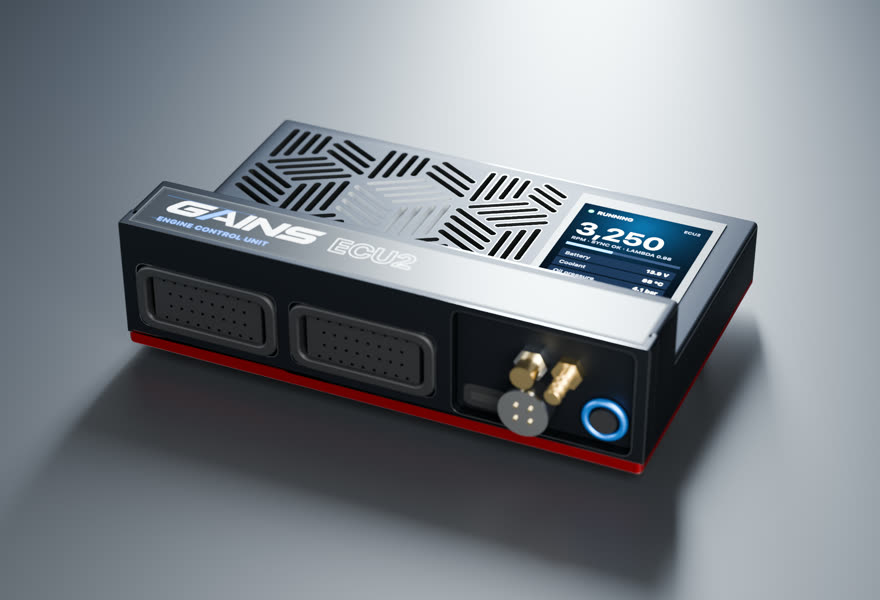
- Price TBA
ECU2Engine controller
6 cyl · port injection · drive-by-wire
Full sequential fuel and spark for this 6-cylinder, and its electronic throttle, with the wideband built in.
in designEst. availability: April 2027
Add PDM2 to switch and protect chassis loads (pumps, fans, lights, accessories). Add it in the configurator →
Track days? Add the Telemetry Dongle Pro for 25 Hz GPS lap timing; it plugs into the OBD-II port, and your phone is the dash. Plan it in the configurator →
What you get
- A screen on the ECUA 2.4-inch, 500-nit display in the lid, readable in a footwell.
- Faults in plain words"Coolant temp sensor open circuit.
- Drive-by-wire built inFour half-bridges run up to two electronic throttles, with pedal and throttle sensors on the ECU's own inputs and a windowed watchdog that cuts the motors in hardware on a fault.
- S3-style harnessesConnector A and C pin functions follow the published Nexus S3 wiring diagram.
- Powered CAN portA sealed 4-pin port on the insert carries 12 V and CAN for the PDM2 and GAINS displays: one cable per accessory.
- GAINS insideThe on-ECU adaptive layer, the app, logging and your limits.
How it wires in
- Haltech S3 plug-in harnessNone listed for this car
- Factory-connector → S3 adapterNone listed for this car
- Wire-inYour route: universal wire-in harness
Pin-compatible per the published S3 pinout, not yet fit-tested. Every harness option for this car ↓
ECU2 is in design; specifications may change. All GAINS hardware is pre-release concept design; nothing is for sale yet and no application is validated on a vehicle. Harness fitment is from published pinouts and not yet fit-tested.
How GAINS approaches the Falcon / Territory BA-FG-X
Our starting method for this engine, as foundations first: get it running and drivable, then learn fuel, then the hardware-specific strategies. It is a methodology outline, not a validated calibration.
- 1Base map and first startplanned
Start from displacement, injector data and the sensors fitted, then let the first-start learner settle cranking, idle and warm-up before any load work. The goal is a safe, running engine, not a finished calibration.
- 2Lambda targets and VE learningclosed loop on GAINS ECUs
Air-fuel targets come from your goal (street, track, economy). The ECU then learns its fuel table cell by cell from the onboard wideband inside a signed envelope, and you approve promoting what it learned into the base map.
- 3Cam phasing (VVT)gated
Begin with conservative overlap. Cam targets per load cell are then chosen with torque and knock in mind, keeping idle and cold overlap low for stability. Widening cam authority follows the same evidence-gated path as spark.
- 4Drivability foundationsplanned
Pedal map, tip-in and decel fuel, idle control, cold start and warm-up enrichment: the tables tuners spend hours on after the main map. Each is a strategy in the knowledge engine with its own limits.
- 5Wideband sensorhardware
factory O2 type not yet sourced; plan on a Bosch LSU 4.9 for the GAINS ECU's built-in controller
- 6Bottom end and head sealingfactory reference
Reported: Forum and Australian press name the rods and rod bolts as the first limit, especially at high rpm or heavy low-rpm boost. Main-cap walk is reported, and the stock crank has seen over 700 hp. (medium confidence) Limits depend on tune quality, fuel, rpm and condition and are not guaranteed.
Drivetrain
Five-speed T5 (182) and T5Z (240T). BA Mk II XR6 Turbo moved to a six-speed T56.
Sourced · medium612- ZF 6HP26 six-speed automatic introduced (XR6 Turbo and others)
- BTR M93LE four-speed on Barra 190
- Six-speed T56 manual on turbo and XR6
5R55S five-speed automatic on early NA models, with ZF six-speed optional (standard from July 2010). ZF 6HP26 on XR6 Turbo/G6E Turbo. TR-6060 six-speed manual. M93LE on E-Gas.
Sourced · medium8- Control Blade independent rear suspension on sedans from BA
- Wagons and utes kept a leaf-sprung live axle (BA)
- 2.73:1 open differential on five- and six-speed autos
- LSD optional on XR6, standard on XR6 Turbo
Single-speed BorgWarner Torque-On-Demand transfer case, rear-biased, clutch-engaged up to a 50:50 split
Sourced · medium4Chassis integration
- FG Mk II has generation 9.0 dynamic stability control
- BF Mk III added DSC on petrol models
BA-on Falcons use an Interior Command Centre (ICC) head unit/body interface that depends on PATS being active
Sourced · medium10The FG and FG X put more on the CAN network. The PCM depends on ABS or TCM speed data, and the cluster, ICC and stability control share engine data over the bus. Any controller replacement on an FG must either keep the factory PCM in the loop or supply the expected CAN traffic. Otherwise the gauges, stability control and speed-dependent functions will misbehave.
Tuning notes
About 6 psi (BA/BF GT3582R), about 10 psi (FG GT3576R), about 1 bar on FPV 310T
Sourced · medium135Flex fuel (E85/98), gear- or speed-based boost control and dual maps in commercial reflash tools
Sourced · medium9When changing final drive or transmission, update the vehicle ratio data in the calibration so that speed-based functions (torque limiting, boost by speed, cluster speed) stay correct. On turbo cars, gear-based boost control is the main protection for the stock rods and gearbox in the lower gears.
Popular swaps
GAINS on the Falcon / Territory BA-FG-X
ECU2
Designed so your phone is the laptop, keypad and dash
The GAINS app is designed to handle tuning, logging, gauges and switch inputs over Bluetooth, so the system needs no separate CAN keypad or display. Keypad, dash and logging views are planned; the iOS prototype runs on simulated data today.
Wideband, IMU and logging built in
An onboard Bosch LSU 4.9 wideband controller, a 6-axis IMU and onboard logging are designed into the ECU rather than sold as add-on modules.
Modular, so you buy what the engine needs
This engine runs on ECU2. PDM2 (power, body and gearbox) is optional and connects over ECU2's powered CAN port; the Telemetry Dongle Pro adds GPS lap timing from the OBD-II port.
Calibration that keeps learning
Instead of a fixed map that drifts as parts and conditions change, the ECU keeps adapting its fuel trims within limits you can see and approve in the app.
Adaptive tuning strategies
- VE learning closed loop on GAINS ECUs
Learns the fuel table from the onboard wideband as you drive, cell by cell, inside a signed authority envelope. Learned trims are promoted into the base map without a step in fuelling.
- Goal-based lambda targets closed loop on GAINS ECUs
Sets air-fuel targets from your goal (economy, response, power, safety margin) instead of a single fixed table.
- Knock protection protection
Listens for knock on a dedicated knock processor, pulls timing at once and restores it slowly. It only ever reduces advance.
- Warm-up, cranking, idle and transient fuel planned
The same learning approach applied to the tables tuners spend hours on after the main map is done.
- Spark advance and boost authority gated
Widening ignition advance or boost is never automatic. It stays an expert or dyno decision until validated knock detection exists for the engine family.
Already running another ECU? In advisor mode the same strategies read your logs and recommend exact table changes with the reasoning, which you apply in your ECU vendor's own software.
GAINS hardware is pre-release concept design. Simulated results only; nothing is validated on a vehicle yet.
Frequently asked
Can I disable PATS on a Falcon PCM for an engine swap?
On BA/BF PCMs, yes, through calibration. The BCM/ICC then stops working, so it suits race cars and swaps without the factory dash. FG/FG X PCMs have a different CAN setup and also need a CAN speed source.10
Why won't my FG Barra run properly without the ABS module?
The FG PCM only accepts vehicle speed over CAN from the ABS or TCM and ignores alternative speed-source settings. Without it, you need a CAN emulator or a calibration with the speed-dependent functions tuned out.10
What automatic is in the XR6 Turbo?
BA XR6 Turbo used a BTR four-speed (M95LE). BF and FG XR6 Turbo use the ZF 6HP26 six-speed.678
Which manual gearbox came in the FG XR6 Turbo?
A Tremec TR-6060 six-speed.8
Can all BA to FG X Falcons be tuned through the factory PCM?
Yes, all petrol BA, BF, FG and FG X Falcons and petrol Territories can, with commercial tools. EcoBoost Falcon and diesel Territory are the exceptions.9
Sources
Numbered as cited above. Hover or tap a citation chip to preview it.
- Ford Barra 240T turbo engine · Australian Car Reviews · press · retrieved 2026-10-25
- Ford Barra 245T turbo engine · Australian Car Reviews · press · retrieved 2026-10-25
- Ford Barra 270T turbo engine · Australian Car Reviews · press · retrieved 2026-10-25
- Ford SZ Territory (AWD system description) · Australian Car Reviews · press · retrieved 2026-10-25
- Ford Barra engine · Wikipedia · community · retrieved 2026-10-25
- Ford Falcon (BA) · Wikipedia · community · retrieved 2026-10-25
- Ford Falcon (BF) · Wikipedia · community · retrieved 2026-10-25
- Ford Falcon (FG) · Wikipedia · community · retrieved 2026-10-25
- PCMTec General Fact Sheet · PCMTec · vendor-doc · retrieved 2026-10-25
- How to run PCM standalone (engine swap): PATS disable and speed source setup · PCMTec · vendor-doc · retrieved 2026-10-25
- Ford's Barra engine: Everything you need to know · CarsGuide · press · retrieved 2026-10-25
- Extraordinary Engines: Ford Barra Turbo · Retro Rides · press · retrieved 2026-10-25
Catalog data and evidence
- Catalog data, not yet expert-reviewed.
- No vehicle photos: illustrations only until licensed imagery is available.
- Factory ECU part numbers not yet sourced for this vehicle.
- E-900 Haltech Nexus S3 catalog (sourced, high confidence)
- E-941 S3 engine harness availability (inferred, medium confidence)