

Engine: 4G63T (Evo I-IX)
Part of the Mitsubishi 4G63 family.
Modeled power and torque
Modelled estimate, not a dyno result.
Modeled estimate, not a dyno measurement. Real results vary with fuel, weather, dyno type and build.
Stock is anchored to the factory rating (286 hp at 6500 rpm, 289 lb-ft at 3500 rpm); the curve shape between peaks is modeled. Bolt-ons + tune (pump fuel, more boost): Stock turbo/supercharger; gains limited by compressor and fuel system.
4G63T (Evo I-IX) data
- Load sensing
- MAF (Karman vortex)
- O2 sensor
- Not yet sourced
- Closed loop
- Not yet sourced
- Block
- cast iron
- Rods / pistons
- forged steel (2003 US Evo, Wikipedia)
- Reported limit
- 600+ whp reported on stock blocks (DSPORT; block, not internals)
- Factory
- Top-feed, low-impedance with resistor pack (Evo 8/9)
- Impedance
- low (peak and hold)
- Direct-fit upgrades
- 6 maker-listed
- Knock
- piezo knock sensor
- MAP / MAF
- Karman vortex, frequency (integrated IAT and baro)
- O2 (upstream)
- narrowband zirconia
Platform background
The CT9A Evolution VII-IX moved to the larger Lancer Cedia platform and brought the 4G63T to the US market for 2003. The USDM Evo VIII service manual documents the full ECM terminal list, sensor types (Karman vortex VAF, Hall crank and cam sensors, piezo knock sensor) and fuel system data. The Evo IX added MIVEC intake cam phasing through an oil control valve, a boost sensor and a separate IAT sensor, so its ECM wiring differs from the Evo VIII table reproduced here.
Factory ECU
Karman vortex volume airflow sensor with built-in barometric pressure and IAT sensors
Sourced21- Sequential MPI
- Closed loop on the front zirconia heated O2 sensor after warm-up, open loop when cold or at high load
- Single piezoelectric knock sensor
- The ECU falls back to a milder timing map when knock is detected
Duty-cycle wastegate solenoid (29-35 ohm). The stock ECU reduces boost when airflow exceeds its expectation.
Sourced25- Two molded coils with built-in power transistors firing 1/4 and 2/3 as wasted-spark pairs
- ECM selects the coil from cam and crank sensor signals
The USDM Evo VIII ECM uses four terminal blocks (1-26, 31-46, 51-62, 71-92). Injectors are low impedance (2-3 ohm) and fed through a 5.5-6.5 ohm injector resistor, so each injector circuit measures 7.8-9.2 ohm at the ECM. The ignition outputs are logic-level drives to two coils with built-in power transistors. Crank and cam sensors are Hall element types.
Factory ECU: harness cross-reference
From the factory ECU each listed harness plugs into. The factory ECU is unplugged, not modified. Check the label and part number on your own ECU before ordering.
- ECU family
- Mitsubishi MD-series ECU, E2T case codes (e.g. E2T67380)
- Applies to
- Evo IV-VIII 5-speed all regions; Evo VIII MR USDM; Eclipse/Talon 2G turbo USDM; manual
- Not for
- not 6-speed JDM Evo VIII MR or Evo IX (use HT-186360); not automatic
- Supplier
- Mitsubishi Electric
Examples only: MD334794 (case E2T67380) listed as Evo IV; MD356472 as Evo IV-VI GSR. Evo VII/VIII and 2G Eclipse numbers not confirmed. Harness spans several ECU generations.
- ECU family
- Mitsubishi 1860A-series, case E6T46981
- Applies to
- Evo IX all regions; Evo VIII MR 6-speed JDM; manual
- Not for
- Evo IV-VIII 5-speed (use HT-186332); automatic
- Supplier
- Mitsubishi Electric
Single listing example; 1860A prefix shared with other Mitsubishi models (e.g. Colt), so confirm by label.
- ECU family
- Mitsubishi Lancer Evolution VIII (CT9A) ECU
- Applies to
- 2003-2005 Evo VIII USDM and Evo VIII 260, manual
- Not for
- not Evo VIII MR/Evo IX unless harness states
No OEM number found from allowed sources. Boomslang splits Evo VIII across two SKUs (BF29051 for 260/USDM and BF29119); reports elsewhere of two Evo VIII ECU connector layouts could not be confirmed from an allowed source.
- ECU family
- Mitsubishi Lancer Evolution VII ECU
- Applies to
- 2000-2003 Evo VII, manual; JDM
- Not for
- GT-A automatic
No OEM number found.
- ECU family
- Mitsubishi Lancer Evolution IX (CT9A) ECU
- Applies to
- 2005-2007 Evo IX, manual
- Supplier
- Mitsubishi Electric
1860A576 (label E6T46981) from a single resale listing; example only. E6T prefix = Mitsubishi Electric item code (inferred).
- ECU family
- Mitsubishi Lancer Evolution VIII (CT9A) ECU
- Applies to
- 2003-2005 Evo VIII, manual
No OEM number found. See BF29051-S3: Boomslang offers two Evo VIII SKUs, reason (ECU/connector variant) not confirmed from an allowed source.
Factory ECU pinout
Each connector face drawn from the OEM service manual's pin data, with every terminal's function and wire colour where the manual prints it.
Mitsubishi Lancer Evolution VII-IX ECM (4G63T), USDM Evo VIII
The Mitsubishi Lancer Evolution VII-IX ECM (4G63T), USDM Evo VIII uses 1 connector with 76 cavities. This page draws each face from the OEM figure and lists the 58 terminals the OEM table documents, with wire colours where the manual prints them.
2003-2005 (USDM Evo VIII manual) · US · 1 connector, 76 cavities · 58 terminals sourced
Looking into the ECU's connector. The harness plug seen from its wire side has the same layout.
How the OEM figure is oriented
ECU header side, as drawn in the OEM figure. Side confidence: medium.| Pin | Function | Type | Wire | Notes |
|---|---|---|---|---|
| 1 | No.1 injector | Injector | — | |
| 2 | No.3 injector | Injector | — | |
| 3 | Fuel pressure solenoid (hot-start) | Outputs | — | |
| 4 | IAC stepper motor coil A1 | Outputs | — | |
| 5 | IAC stepper motor coil B1 | Outputs | — | |
| 6 | EGR vacuum regulator solenoid valve | Outputs | — | |
| 8 | A/C compressor clutch relay | Outputs | — | |
| 9 | Evaporative emission purge solenoid | Outputs | — | |
| 10 | Ignition coil No.1/No.4 (power transistor drive) | Ignition | — | |
| 11 | Turbocharger wastegate solenoid | Outputs | — | |
| 12 | Power supply (from MFI relay) | Outputs | — | |
| 13 | ECM ground | Ground | — | |
| 14 | No.2 injector | Injector | — | |
| 15 | No.4 injector | Injector | — | |
| 17 | IAC stepper motor coil A2 | Outputs | — | |
| 18 | IAC stepper motor coil B2 | Outputs | — | |
| 19 | Volume airflow sensor reset signal | Sensor signal | — | |
| 21 | Fan control module (radiator fan) | Outputs | — | |
| 22 | Fuel pump relay | Outputs | — | |
| 23 | Ignition coil No.2/No.3 (power transistor drive) | Ignition | — | |
| 24 | A/C switch 2 (A/C load) | Sensor signal | — | |
| 25 | Power supply (from MFI relay) | Outputs | — | |
| 26 | ECM ground | Ground | — | |
| 32 | Condenser fan relay HI | Outputs | — | |
| 33 | Generator G terminal | Outputs | — | |
| 34 | Condenser fan relay LO | Outputs | — | |
| 36 | Malfunction indicator lamp (SERVICE ENGINE SOON) | Comms / diag | — | |
| 37 | Power steering pressure switch | Sensor signal | — | |
| 38 | MFI relay control (power supply relay) | Outputs | — | |
| 39 | Fuel pump relay 3 (pump speed) | Outputs | — | |
| 41 | Generator FR terminal | Sensor signal | — | |
| 44 | Charge air cooler water spray switch (AUTO) | Sensor signal | — | |
| 45 | A/C switch | Sensor signal | — | |
| 54 | Heated oxygen sensor heater (rear) | Outputs | — | |
| 55 | Evaporative emission ventilation solenoid | Outputs | — | |
| 57 | Charge air cooler water spray relay | Outputs | — | |
| 58 | Tachometer signal | Comms / diag | — | |
| 60 | Heated oxygen sensor heater (front) | Outputs | — | |
| 61 | Fuel tank differential pressure sensor | Sensor signal | — | |
| 71 | Ignition switch ST | Sensor signal | — | |
| 72 | Intake air temperature sensor | Sensor signal | — | |
| 73 | Manifold differential pressure sensor | Sensor signal | — | |
| 75 | Heated oxygen sensor signal (rear) | Sensor signal | — | |
| 76 | Heated oxygen sensor signal (front) | Sensor signal | — | |
| 77 | Fuel tank temperature sensor | Sensor signal | — | |
| 80 | Backup power supply | Power | — | |
| 81 | Sensor supply voltage (4.5-5.5 V) | Sensor 5 V / ground | — | |
| 82 | Ignition switch IG | Power | — | |
| 83 | Engine coolant temperature sensor | Sensor signal | — | |
| 84 | Throttle position sensor | Sensor signal | — | |
| 85 | Barometric pressure sensor | Sensor signal | — | |
| 86 | Vehicle speed sensor | Sensor signal | — | |
| 87 | Idle position switch | Sensor signal | — | |
| 88 | Camshaft position sensor | Crank / cam | — | |
| 89 | Crankshaft position sensor | Crank / cam | — | |
| 90 | Volume airflow sensor signal | Sensor signal | — | |
| 91 | Charge air cooler water spray switch (MANUAL) | Sensor signal | — | |
| 92 | Sensor ground (reference terminal in the IAT and ECT resistance checks) | Sensor 5 V / ground | — | (medium confidence) |
Our drawing from published pin data; not an OEM drawing. Layout from the OEM face view (medium confidence). Confirm against the factory manual for your exact year and market before cutting or pinning wires.
Coverage, year splits and safety
Transcribed from the USDM Lancer Evolution VIII service manual, Group 13A. The Evo IX (MIVEC) and JDM Evo VII ECUs differ on some terminals and were not checked against their own manuals.
Source notes: From the USDM Lancer Evolution VIII service manual, Group 13A, 'Check at the Engine Control Module (ECM)' terminal voltage and resistance charts (ECM E6T34880). This applies to the 2003-05 USDM Evo VIII. Evo VII (JDM/Euro) and Evo IX ECMs differ (the IX adds the MIVEC OCV, boost sensor and IAT). Get the Evo IX vehicle service manual's Group 13A ECM terminal chart before wiring an IX. Wire colours are not in these tables.
Safety: disconnect the battery before working on the ECU harness, and confirm each terminal with a meter against your own car's manual before cutting or pinning wires.
Plug-and-play harness
A plug-in harness built for the Haltech Nexus S3 pinout is listed for this vehicle. The ECU2 follows that published pinout, so the factory ECU is unplugged and the ECU2 plugs into the car's own loom. Nothing is written to the factory ECU. Pin-compatible per the published S3 pinout, not yet fit-tested.
| Maker | Harness | Fits | Link | |
|---|---|---|---|---|
 | Mitsubishi EVO 4-8 & 2GHT-186332 | Evo IV-VIII 5-speed all regions; Evo VIII MR USDM; Eclipse/Talon 2G turbo USDM; manual | $535Lowest | Maker ↗ |
| Mitsubishi EVO 9 & EVO 8MRHT-186360 | Evo IX all regions; Evo VIII MR 6-speed JDM; manual | $535Lowest | Maker ↗ |
 | Manual 2003 - 2005 Mitsubishi EVO VIII 260BF29051-S3 | 2003-2005 Evo VIII USDM and Evo VIII 260, manual | $840 | Maker ↗ |
| Manual 2000 - 2003 Mitsubishi EVO VIIBF29123-S3 | 2000-2003 Evo VII, manual; JDM | $840 | Maker ↗ |
| Manual 2005 - 2007 Mitsubishi EVO IXBF29053-S3 | 2005-2007 Evo IX, manual | $960 | Maker ↗ |
| Manual 2003 - 2005 Mitsubishi EVO VIIIBF29119-S3 | 2003-2005 Evo VIII, manual | $960 | Maker ↗ |
| Wire-in | Universal flying lead or re-terminated factory harness | Any engine (terminate to ECU2's two Superseal 34 connectors) | Universal harness from $405 | Maker ↗ |
Nexus S3 Plug n Play Adapter Harness Mitsubishi EVO 4-8 & 2G
- Plugs into
Mitsubishi 4G63T ECU (Evo IV-VIII / Eclipse 2G Turbo) · MD334794, MD356472
- OEM part numbers
- MD334794, MD356472
- ECU
- Mitsubishi Electric · Mitsubishi MD-series ECU, E2T case codes (e.g. E2T67380)
- Confidence
- low
Examples only: MD334794 (case E2T67380) listed as Evo IV; MD356472 as Evo IV-VI GSR. Evo VII/VIII and 2G Eclipse numbers not confirmed. Harness spans several ECU generations.
Sources: E-1443
- Fits
- Evo IV-VIII 5-speed all regions; Evo VIII MR USDM; Eclipse/Talon 2G turbo USDM; manual
- Exclusions
- not 6-speed JDM Evo VIII MR or Evo IX (use HT-186360); not automatic
- SKU
- HT-186332
- Maker fitment
- Mitsubishi EVO 4-8 (5-speed, all regions), EVO 8 MR (USDM), Eclipse 2G Turbo (USDM); manual only
- Maker notes
- kit HT-213308
Nexus S3 Plug n Play Adapter Harness Mitsubishi EVO 9 & EVO 8MR
- Plugs into
Mitsubishi Evo IX / VIII MR ECU · 1860A576
- OEM part numbers
- 1860A576
- ECU
- Mitsubishi Electric · Mitsubishi 1860A-series, case E6T46981
- Confidence
- low
Single listing example; 1860A prefix shared with other Mitsubishi models (e.g. Colt), so confirm by label.
Sources: E-1442
- Fits
- Evo IX all regions; Evo VIII MR 6-speed JDM; manual
- Exclusions
- Evo IV-VIII 5-speed (use HT-186332); automatic
- SKU
- HT-186360
- Maker fitment
- Mitsubishi EVO 9 (all regions), EVO 8 MR 6-speed (JDM only); manual only
- Maker notes
- DISCONTINUED (No longer available); kit HT-213318 also discontinued; EVO 9 / 8MR only
Boomslang plug-and-play harness for Haltech Nexus S3 - Manual 2003 - 2005 Mitsubishi EVO VIII 260
- Plugs into
Evo VIII ECU (4G63T, 2003-05 USDM / 260 variant)
- ECU
- Mitsubishi Lancer Evolution VIII (CT9A) ECU
- Confidence
- low
No OEM number found from allowed sources. Boomslang splits Evo VIII across two SKUs (BF29051 for 260/USDM and BF29119); reports elsewhere of two Evo VIII ECU connector layouts could not be confirmed from an allowed source.
- Fits
- 2003-2005 Evo VIII USDM and Evo VIII 260, manual
- Exclusions
- not Evo VIII MR/Evo IX unless harness states
- SKU
- BF29051-S3
- Maker fitment
- Mitsubishi EVO VIII 260; Mitsubishi EVO VIII USDM (Manual); selector years 2003-2005; SKU label: Manual 2003 - 2005 Mitsubishi EVO VIII 260
- Maker notes
- separate SKUs exist for other Nexus models (-S2/-R3/-R5/-T1/-T2); EVO VIII 260 / USDM
Boomslang plug-and-play harness for Haltech Nexus S3 - Manual 2005 - 2007 Mitsubishi EVO IX
- Plugs into
Evo IX ECU (4G63T MIVEC, 2005-07) · 1860A576
- OEM part numbers
- 1860A576
- ECU
- Mitsubishi Electric · Mitsubishi Lancer Evolution IX (CT9A) ECU
- Confidence
- low
1860A576 (label E6T46981) from a single resale listing; example only. E6T prefix = Mitsubishi Electric item code (inferred).
Sources: E-1498
- Fits
- 2005-2007 Evo IX, manual
- SKU
- BF29053-S3
- Maker fitment
- Mitsubishi EVO IX (Manual); selector years 2005-2007; SKU label: Manual 2005 - 2007 Mitsubishi EVO IX
- Maker notes
- separate SKUs exist for other Nexus models (-S2/-R3/-R5/-T1/-T2); EVO IX
Boomslang plug-and-play harness for Haltech Nexus S3 - Manual 2003 - 2005 Mitsubishi EVO VIII
- Plugs into
Evo VIII ECU (4G63T, 2003-05)
- ECU
- Mitsubishi Lancer Evolution VIII (CT9A) ECU
- Confidence
- low
No OEM number found. See BF29051-S3: Boomslang offers two Evo VIII SKUs, reason (ECU/connector variant) not confirmed from an allowed source.
- Fits
- 2003-2005 Evo VIII, manual
- SKU
- BF29119-S3
- Maker fitment
- Mitsubishi EVO VIII (Manual); selector years 2003-2005; SKU label: Manual 2003 - 2005 Mitsubishi EVO VIII
- Maker notes
- separate SKUs exist for other Nexus models (-S2/-R3/-R5/-T1/-T2); EVO VIII
Boomslang plug-and-play harness for Haltech Nexus S3 - Manual 2000 - 2003 Mitsubishi EVO VII
- Plugs into
ECU (4G63T, Evo VII, CT9A)
- ECU
- Mitsubishi Lancer Evolution VII ECU
- Confidence
- low
No OEM number found.
- Fits
- 2000-2003 Evo VII, manual; JDM
- Exclusions
- GT-A automatic
- SKU
- BF29123-S3
- Maker fitment
- Mitsubishi EVO VII (Manual); selector years 2000-2003; SKU label: Manual 2000 - 2003 Mitsubishi EVO VII
- Maker notes
- separate SKUs exist for other Nexus models (-S2/-R3/-R5/-T1/-T2); EVO VII
Haltech and Boomslang are trademarks of their respective owners. GAINS is not affiliated with or endorsed by them.
Your GAINS system for this car · pre-release
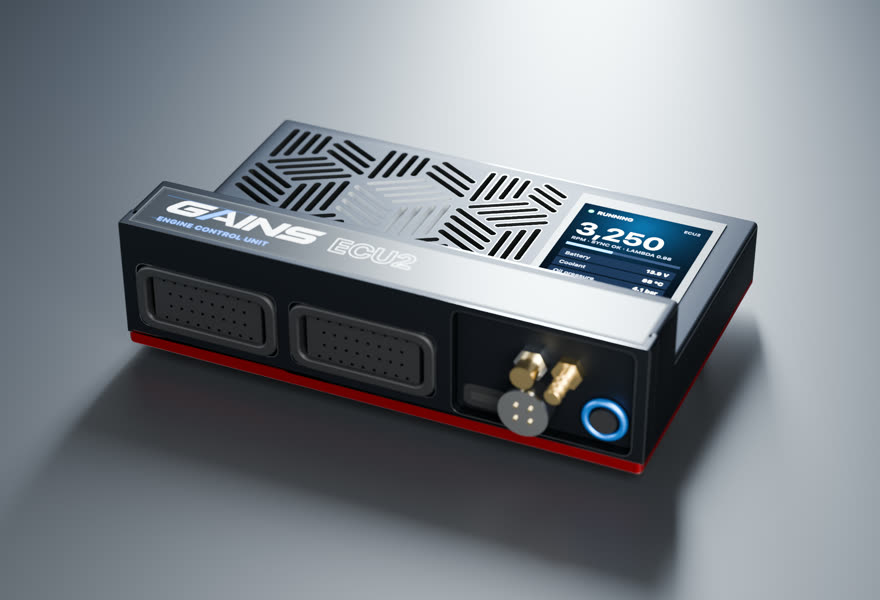
ECU2 for the Lancer Evolution VII-IX
Planned with the same rules as the configurator for this car's 4 cyl · port injection · cable throttle. The factory ECU is unplugged and replaced; nothing is written to it.
- Price TBA
ECU2Engine controller
4 cyl · port injection · cable throttle
Full sequential fuel and spark for this 4-cylinder on a cable throttle, with the wideband built in.
in designEst. availability: April 2027
Add PDM2 to switch and protect chassis loads (pumps, fans, lights, accessories). Add it in the configurator →
Track days? Add the Telemetry Dongle Pro for 25 Hz GPS lap timing; it plugs into the OBD-II port, and your phone is the dash. Plan it in the configurator →
What you get
- A screen on the ECUA 2.4-inch, 500-nit display in the lid, readable in a footwell.
- Faults in plain words"Coolant temp sensor open circuit.
- S3-style harnessesConnector A and C pin functions follow the published Nexus S3 wiring diagram.
- Powered CAN portA sealed 4-pin port on the insert carries 12 V and CAN for the PDM2 and GAINS displays: one cable per accessory.
- GAINS insideThe on-ECU adaptive layer, the app, logging and your limits.
How it wires in
- Haltech S3 plug-in harness2 listed · from $535 USD listHT-186332
- Factory-connector → S3 adapter4 listed · from $840 USD list
- Wire-inAlways possible
Pin-compatible per the published S3 pinout, not yet fit-tested. Every harness option for this car ↓
ECU2 is in design; specifications may change. All GAINS hardware is pre-release concept design; nothing is for sale yet and no application is validated on a vehicle. Harness fitment is from published pinouts and not yet fit-tested.
How GAINS approaches the Lancer Evolution VII-IX
Our starting method for this engine, as foundations first: get it running and drivable, then learn fuel, then the hardware-specific strategies. It is a methodology outline, not a validated calibration.
- 1Base map and first startplanned
Start from displacement, injector data and the sensors fitted, then let the first-start learner settle cranking, idle and warm-up before any load work. The goal is a safe, running engine, not a finished calibration.
- 2Lambda targets and VE learningclosed loop on GAINS ECUs
Air-fuel targets come from your goal (street, track, economy). The ECU then learns its fuel table cell by cell from the onboard wideband inside a signed envelope, and you approve promoting what it learned into the base map.
- 3Cam phasing (VVT)gated
Begin with conservative overlap. Cam targets per load cell are then chosen with torque and knock in mind, keeping idle and cold overlap low for stability. Widening cam authority follows the same evidence-gated path as spark.
- 4Boost controlgated
A closed-loop boost target by gear and goal, held inside the authority envelope, with knock protection active at boost. Raising boost authority is never automatic; it stays an expert or dyno decision.
- 5Drivability foundationsplanned
Pedal map, tip-in and decel fuel, idle control, cold start and warm-up enrichment: the tables tuners spend hours on after the main map. Each is a strategy in the knowledge engine with its own limits.
- 6Factory load sensingfactory reference
What the factory ECU measures load with: MAF (Karman vortex) (medium confidence)
- 7Wideband sensorhardware
factory O2 type not yet sourced; plan on a Bosch LSU 4.9 for the GAINS ECU's built-in controller
- 8Bottom end and head sealingfactory reference
Reported: DSPORT reports the iron block as strong, with hundreds of stock-block examples beyond 600 whp; rods/pistons typically cited first (forum). (medium confidence) Limits depend on tune quality, fuel, rpm and condition and are not guaranteed.
Drivetrain
Chassis integration
Charge air cooler water spray switches (44 AUTO, 91 MANUAL) and relay (57)
Sourced2Vehicle speed sensor input terminal 86 (electromagnetic resistance element type)
Sourced2A standalone ECU on a US car must replace the MIL, tachometer, fan control module, condenser fan and A/C clutch logic, the generator G/FR control and the EVAP devices, or deliberately delete them. The ACD and AYC controllers are separate modules that use engine data; check their inputs before removing the factory ECM.
Tuning notes
Expect the factory ECM to pull timing on 91-octane fuel and to cut boost on high airflow. Both make results from bolt-ons inconsistent until the calibration is changed. On the IX, verify the MIVEC OCV and filter are clean before tuning; a sticky VVT costs torque.
Popular swaps
GAINS on the Lancer Evolution VII-IX
ECU2
Designed so your phone is the laptop, keypad and dash
The GAINS app is designed to handle tuning, logging, gauges and switch inputs over Bluetooth, so the system needs no separate CAN keypad or display. Keypad, dash and logging views are planned; the iOS prototype runs on simulated data today.
Wideband, IMU and logging built in
An onboard Bosch LSU 4.9 wideband controller, a 6-axis IMU and onboard logging are designed into the ECU rather than sold as add-on modules.
Modular, so you buy what the engine needs
This engine runs on ECU2. PDM2 (power, body and gearbox) is optional and connects over ECU2's powered CAN port; the Telemetry Dongle Pro adds GPS lap timing from the OBD-II port.
Calibration that keeps learning
Instead of a fixed map that drifts as parts and conditions change, the ECU keeps adapting its fuel trims within limits you can see and approve in the app.
Adaptive tuning strategies
- VE learning closed loop on GAINS ECUs
Learns the fuel table from the onboard wideband as you drive, cell by cell, inside a signed authority envelope. Learned trims are promoted into the base map without a step in fuelling.
- Goal-based lambda targets closed loop on GAINS ECUs
Sets air-fuel targets from your goal (economy, response, power, safety margin) instead of a single fixed table.
- Knock protection protection
Listens for knock on a dedicated knock processor, pulls timing at once and restores it slowly. It only ever reduces advance.
- Warm-up, cranking, idle and transient fuel planned
The same learning approach applied to the tables tuners spend hours on after the main map is done.
- Spark advance and boost authority gated
Widening ignition advance or boost is never automatic. It stays an expert or dyno decision until validated knock detection exists for the engine family.
Already running another ECU? In advisor mode the same strategies read your logs and recommend exact table changes with the reasoning, which you apply in your ECU vendor's own software.
GAINS hardware is pre-release concept design. Simulated results only; nothing is validated on a vehicle yet.
Frequently asked
What are the Evo 8 crank and cam sensor ECU pins?
Crankshaft position sensor on ECM terminal 89, camshaft position sensor on 88, with the 5 V sensor supply on 81. Both are Hall element sensors.2
Does the Evo 8 have an injector resistor?
Yes. The USDM manual lists a 5.5-6.5 ohm injector resistor feeding 2-3 ohm injectors (MDL560P).2
What MAF does the Evo 8 use?
A Karman vortex volume airflow sensor with built-in baro and IAT sensors. Its signal enters on terminal 90, with the reset/filter line on 19.2
What did the Evo 9 add over the Evo 8?
Variable valve timing (MIVEC) via an oil-controlled VVT sprocket, a revised No.2 ring gap, an intake air temperature sensor and a boost sensor.4
Why does my stock Evo 8 make inconsistent power on the dyno?
The stock ECU switches from an aggressive timing map to a milder one when it detects knock, and cuts boost on high airflow. 91-octane fuel and airflow increases both trigger this.5
Sources
Numbered as cited above. Hover or tap a citation chip to preview it.
- Lancer Evolution VIII Service Manual (MMSA), Group 13A Multiport Fuel Injection - General Description and Diagnosis (part A) · Mitsubishi Motors (hosted by EvoScan, archived) · service-manual · retrieved 2026-10-25
- Lancer Evolution VIII Service Manual (MMSA), Group 13A - Check at the ECM, Terminal Voltage Check Chart, Specifications (part F) · Mitsubishi Motors (hosted by EvoScan, archived) · service-manual · retrieved 2026-10-25
- Lancer Evolution VIII Service Manual, Group 16 Engine Electrical · Mitsubishi Motors (hosted by EvoScan, archived) · service-manual · retrieved 2026-10-25
- Lancer Evolution IX 4G6 DOHC Engine Service Manual Supplement (March 2005) · Mitsubishi Motors Corporation (hosted by EvoScan, archived) · service-manual · retrieved 2026-10-25
- 2003 Mitsubishi Evolution VIII 4G63T Part 1 (Test n Tune) · DSPORT Magazine · press · retrieved 2026-10-25
- 2006 Mitsubishi Lancer Evolution IX (reproduction of Mitsubishi Motors North America release) · Supercars.net · press · retrieved 2026-10-25
- Mitsubishi Lancer Evolution · Wikipedia · community · retrieved 2026-10-25
- Mitsubishi Sirius engine (4G63 section) · Wikipedia · community · retrieved 2026-10-25
Catalog data and evidence
- Catalog data, not yet expert-reviewed.
- No vehicle photos: illustrations only until licensed imagery is available.
- E-901 Haltech S3 plug-in harness family (sourced, high confidence)
- E-912 Haltech S3 adapter harness page (sourced, high confidence)
- E-108 Haltech S2/S3 PnP SKUs (sourced, medium confidence)
- E-934 Boomslang identity (sourced, high confidence)
- E-935 Boomslang S3 catalog size (sourced, high confidence)
- E-900 Haltech Nexus S3 catalog (sourced, high confidence)
- E-941 S3 engine harness availability (inferred, medium confidence)
- E-1443 Evo IV-VI ECU (reported, low confidence)
- E-1442 Evo IX ECU (reported, low confidence)
- E-1498 harness ECU xref: Mitsubishi Evo IX (unverified, low confidence)