


Engine: Coyote Gen 1
Part of the Ford Coyote family.
Modeled power and torque
Modelled estimate, not a dyno result.
Modeled estimate, not a dyno measurement. Real results vary with fuel, weather, dyno type and build.
Stock is anchored to the factory rating (412 hp at 6500 rpm, 390 lb-ft at 4250 rpm); the curve shape between peaks is modeled. Intake + exhaust + tune (pump fuel): Typical NA gains come mostly above mid-rpm.
Coyote Gen 1 data
- Load sensing
- MAF (hot-wire / hot-film)
- O2 sensor
- wideband A/F (UEGO) from 2011
- Closed loop
- wideband (UEGO) closed-loop A/F control
- Block
- aluminium (webbed casting reinforcement)
- Rods / pistons
- powdered-metal I-beam · hypereutectic; piston cooling jets standard (removed on 2013-14 GT per Wikipedia)
- Reported limit
- ~600-650 hp for stock rods (AmericanMuscle "general consensus", low authority)
- Factory
- EV14 (standard/long length) · 357 cc/min
- Impedance
- high (saturated)
- Direct-fit upgrades
- 6 maker-listed
- Knock
- Ford AL3Z-12A699-BA -> AL3Z-12A699-A
- MAP / MAF
- Ford BR3Z-12B579-A (Motorcraft AFLS-165 per dealer other-names)
- O2 (upstream)
- Ford 8F9Z-9F472-D (2011-12 upper) | 8F9Z-9F472-H (2012-14 front)
Platform background
This covers port-injected Coyote vehicles: the 2011-2014 S197 Mustang GT (Gen 1), the 2015-2017 S550 Mustang GT (Gen 2), and 2011-2017 F-150 5.0 trucks. All use a Ford PCM with MAF-based load, an electronic throttle and four-cam Ti-VCT, with eight port injectors and eight coil-on-plug outputs. Most performance work is done by reflashing the stock PCM. Swaps out of these vehicles usually use a Ford Performance control pack or the donor harness. A standalone controller needs four cam inputs and four VCT solenoid outputs in addition to the usual V8 channels.
Factory ECU
- Ford powertrain control modulePCM
- The PCM vehicle connector is designated C175B in Ford Performance harness documentation
OBD-II data link connector (C251 in Ford Performance documentation), used for calibration upload and diagnosis
Sourced12MAF-based airflow with modelled load and a torque-based electronic throttle
Sourced · medium34A Ford Performance control-pack PCM fitted to a 2015-17 Mustang GT gives a no-start, so the vehicle PCM is tied to the car's security and network configuration
Sourced · medium1M-6017-A504VA (2011-14 manual, superseded), M-6017-504V (2015-17 manual), M-6017-M50A (2015-17 6R80 automatic). Not for F-150 engines.
Sourced1These PCMs need a full recalibration, not just fuel scaling, after airflow changes. The MAF transfer, load model, torque model and cam tables interact, and mismatches show up as poor throttle response and erratic traction-control intervention.
Factory ECU pinout: pending
No OEM pin table is in our library yet for the Coyote Gen 1 factory ECU. No OEM-grade PCM pin table was found in this research. Required documents: the Ford Mustang Wiring Diagrams (EVTM) for the specific model year (2011-2014 S197 or 2015-2017 S550), and the F-150 equivalent, section 'Electronic Engine Controls', PCM connector pin tables (Ford Performance documentation names the PCM vehicle connector C175B). Ford Performance notes that factory Ford shop manuals are available from Helm Publications. Until then, wire from the harness maker's instructions or the factory service manual.
Factory ECU pinout
No OEM-grade PCM pin table was found in this research. Required documents: the Ford Mustang Wiring Diagrams (EVTM) for the specific model year (2011-2014 S197 or 2015-2017 S550), and the F-150 equivalent, section 'Electronic Engine Controls', PCM connector pin tables (Ford Performance documentation names the PCM vehicle connector C175B). Ford Performance notes that factory Ford shop manuals are available from Helm Publications.
Harness: wire-in
No plug-and-play harness for the S3 pinout is listed for this vehicle yet. The route is a universal wire-in harness: the factory ECU is removed and each circuit is wired to the new ECU from a pinout. Nothing is written to the factory ECU.
Being researched
We're mapping S3 plug-in and factory-connector adapter harnesses to this application.
Universal flying lead or re-terminated factory harness
Always available: terminate the engine side to ECU2's two Superseal 34 connectors. Universal harness from $405 USD list.
Your GAINS system for this car · pre-release
ECU2 for the Mustang S197
Planned with the same rules as the configurator for this car's 8 cyl · port injection · drive-by-wire. The factory ECU is unplugged and replaced; nothing is written to it.

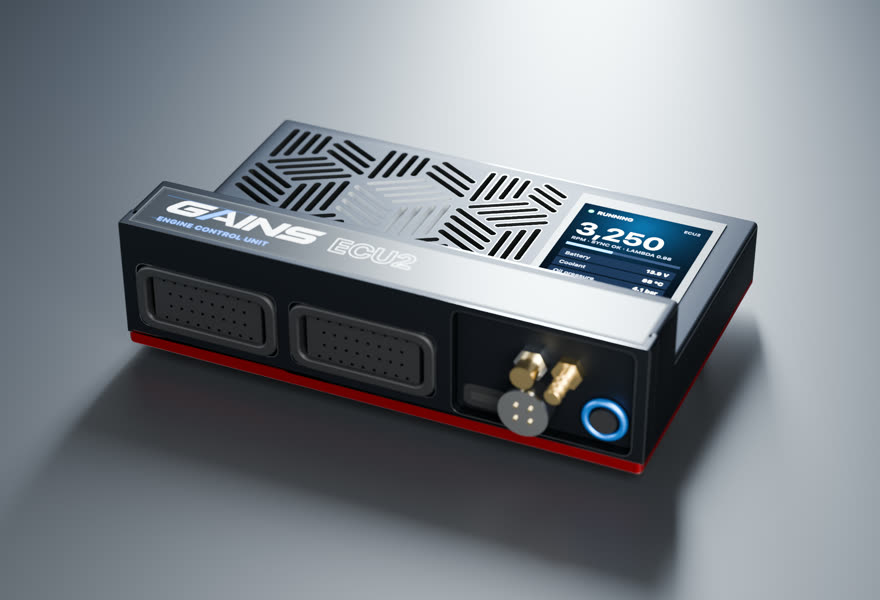
- Price TBA
ECU2Engine controller
8 cyl · port injection · drive-by-wire
Full sequential fuel and spark for this 8-cylinder, and its electronic throttle, with the wideband built in.
in designEst. availability: April 2027
Add PDM2 to switch and protect chassis loads (pumps, fans, lights, accessories). Add it in the configurator →
Track days? Add the Telemetry Dongle Pro for 25 Hz GPS lap timing; it plugs into the OBD-II port, and your phone is the dash. Plan it in the configurator →
What you get
- A screen on the ECUA 2.4-inch, 500-nit display in the lid, readable in a footwell.
- Faults in plain words"Coolant temp sensor open circuit.
- Drive-by-wire built inFour half-bridges run up to two electronic throttles, with pedal and throttle sensors on the ECU's own inputs and a windowed watchdog that cuts the motors in hardware on a fault.
- S3-style harnessesConnector A and C pin functions follow the published Nexus S3 wiring diagram.
- Powered CAN portA sealed 4-pin port on the insert carries 12 V and CAN for the PDM2 and GAINS displays: one cable per accessory.
- GAINS insideThe on-ECU adaptive layer, the app, logging and your limits.
How it wires in
- Haltech S3 plug-in harnessNone listed for this car
- Factory-connector → S3 adapterNone listed for this car
- Wire-inYour route: universal wire-in harness
Pin-compatible per the published S3 pinout, not yet fit-tested. Every harness option for this car ↓
ECU2 is in design; specifications may change. All GAINS hardware is pre-release concept design; nothing is for sale yet and no application is validated on a vehicle. Harness fitment is from published pinouts and not yet fit-tested.
Swap guides
The Coyote Gen 1 family in other cars
How GAINS approaches the Mustang S197
Our starting method for this engine, as foundations first: get it running and drivable, then learn fuel, then the hardware-specific strategies. It is a methodology outline, not a validated calibration.
- 1Base map and first startplanned
Start from displacement, injector data and the sensors fitted, then let the first-start learner settle cranking, idle and warm-up before any load work. The goal is a safe, running engine, not a finished calibration.
- 2Lambda targets and VE learningclosed loop on GAINS ECUs
Air-fuel targets come from your goal (street, track, economy). The ECU then learns its fuel table cell by cell from the onboard wideband inside a signed envelope, and you approve promoting what it learned into the base map.
- 3Cam phasing (VVT)gated
Begin with conservative overlap. Cam targets per load cell are then chosen with torque and knock in mind, keeping idle and cold overlap low for stability. Widening cam authority follows the same evidence-gated path as spark.
- 4Drivability foundationsplanned
Pedal map, tip-in and decel fuel, idle control, cold start and warm-up enrichment: the tables tuners spend hours on after the main map. Each is a strategy in the knowledge engine with its own limits.
- 5Factory load sensingfactory reference
What the factory ECU measures load with: MAF (hot-wire / hot-film) (high confidence)
- 6Wideband sensorhardware
the factory sensor is already an A/F type; for tuning, fit a Bosch LSU 4.9 for the GAINS ECU's built-in controller (factory A/F sensors are not LSU-compatible)
- 7Bottom end and head sealingfactory reference
Reported: Per press quoting Ford engineers, the rods were strong enough for NA use "but only just" and were not meant for forced induction. The hypereutectic pistons are the other limit. (medium confidence) Limits depend on tune quality, fuel, rpm and condition and are not guaranteed.
Drivetrain
Chassis integration
Ford Performance harness connections include the accelerator pedal, data link connector and MIL, starter solenoid, cooling fan feed, alternator, ambient air temperature, an optional EPAS connection, and inlines to the instrument panel and transmission harnesses
Taken from the Gen 4X control pack manual; Gen 1-2 control packs follow the same pattern but should be checked against their own instruction sheet.Sourced · medium2In the car, the PCM shares the vehicle network with the cluster, ABS/stability control and body modules, so engine-speed, coolant and torque-reduction data travel over the network instead of discrete wires. If you replace or relocate the PCM, plan for tach, speedometer, coolant gauge and traction-control behaviour, and for the passive anti-theft system.
Tuning notes
Gen 1 and Gen 2 differ in cams, phasers (Gen 2 mid-lock intake) and intake (Gen 2 CMCV). Do not cross-load calibrations between generations. On boosted cars, verify injector, pump and returnless-system headroom before raising boost. Sweep cam timing in small steps on a dyno before touching spark.
Popular swaps
Coyote swaps from these vehicles typically use a Ford Performance control pack with the matching transmission, plus a return-style fuel system
Sourced1Into these chassis, the most common upgrades are later Coyote parts. Gen 2 heads fit Gen 1 blocks with the 2015 gasket, and cams and chain drives must match the generation. Whole-engine swaps of other families into these cars are uncommon.
Other Mustang S197 guides
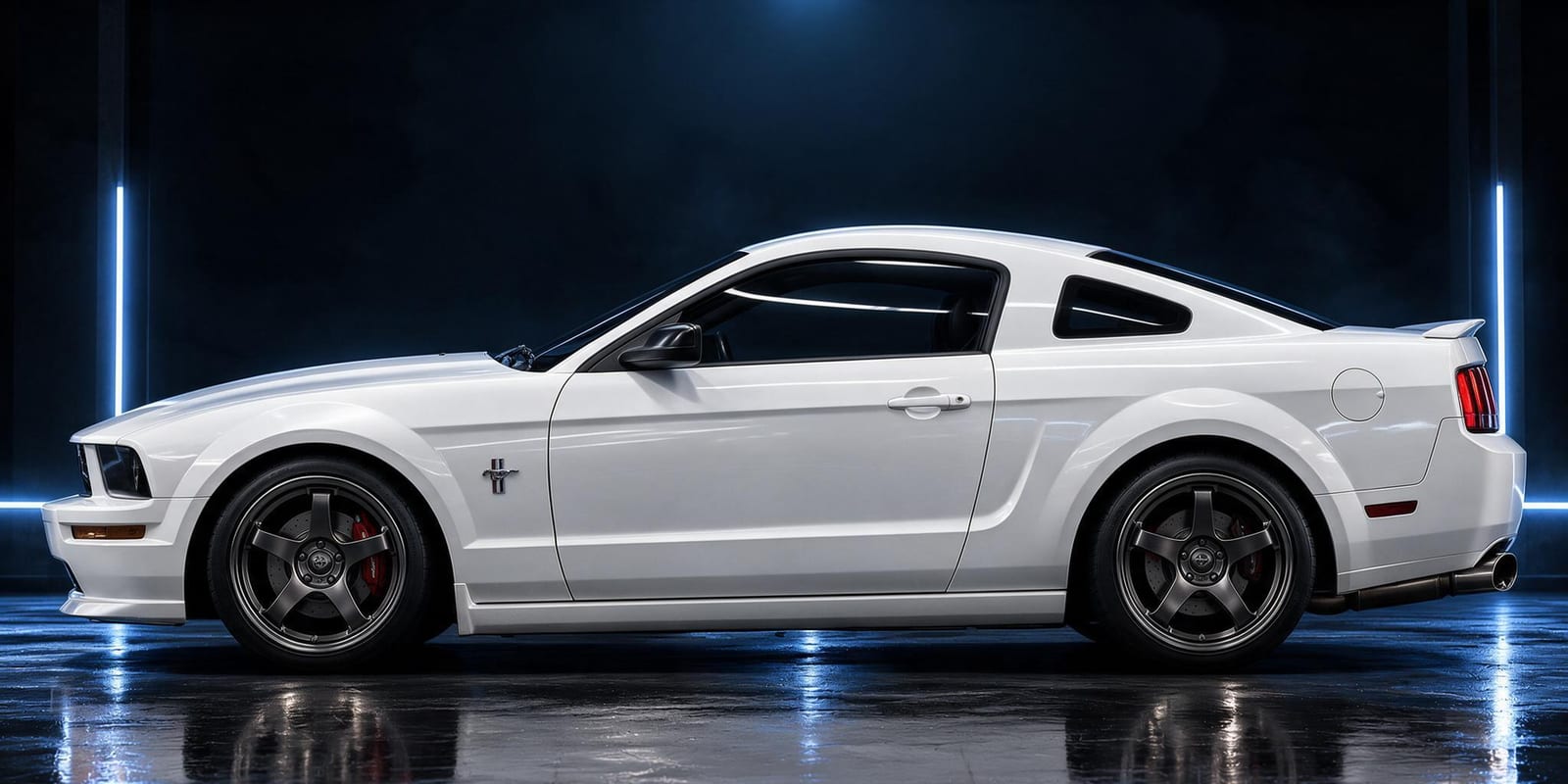
GAINS on the Mustang S197
ECU2
Designed so your phone is the laptop, keypad and dash
The GAINS app is designed to handle tuning, logging, gauges and switch inputs over Bluetooth, so the system needs no separate CAN keypad or display. Keypad, dash and logging views are planned; the iOS prototype runs on simulated data today.
Wideband, IMU and logging built in
An onboard Bosch LSU 4.9 wideband controller, a 6-axis IMU and onboard logging are designed into the ECU rather than sold as add-on modules.
Modular, so you buy what the engine needs
This engine runs on ECU2. PDM2 (power, body and gearbox) is optional and connects over ECU2's powered CAN port; the Telemetry Dongle Pro adds GPS lap timing from the OBD-II port.
Calibration that keeps learning
Instead of a fixed map that drifts as parts and conditions change, the ECU keeps adapting its fuel trims within limits you can see and approve in the app.
Adaptive tuning strategies
- VE learning closed loop on GAINS ECUs
Learns the fuel table from the onboard wideband as you drive, cell by cell, inside a signed authority envelope. Learned trims are promoted into the base map without a step in fuelling.
- Goal-based lambda targets closed loop on GAINS ECUs
Sets air-fuel targets from your goal (economy, response, power, safety margin) instead of a single fixed table.
- Knock protection protection
Listens for knock on a dedicated knock processor, pulls timing at once and restores it slowly. It only ever reduces advance.
- Warm-up, cranking, idle and transient fuel planned
The same learning approach applied to the tables tuners spend hours on after the main map is done.
- Spark advance and boost authority gated
Widening ignition advance or boost is never automatic. It stays an expert or dyno decision until validated knock detection exists for the engine family.
Already running another ECU? In advisor mode the same strategies read your logs and recommend exact table changes with the reasoning, which you apply in your ECU vendor's own software.
GAINS hardware is pre-release concept design. Simulated results only; nothing is validated on a vehicle yet.
Frequently asked
What transmission does the 2011-2017 Mustang GT use?
A Getrag MT82 six-speed manual or a 6R80 six-speed automatic.86
Can I put a Ford Performance control pack PCM in my road-going Mustang GT?
No. Ford Performance states that installing the control-pack PCM in a 2015-17 Mustang GT causes a no-start. The packs are for swaps and off-highway builds.1
Does the F-150 Coyote use the same control pack as the Mustang?
No. Ford Performance's 2015-17 control pack is not for F-150 5.0 engines, which have different cams, compression and calibration.15
Is the S550 8.8 rear the same as the S197 8.8?
Only the 8.8-inch ring-gear size is shared. The S550 IRS centre section, shims, crush sleeve and bearings are different and not interchangeable.9
What compression is the 2011-2014 F-150 5.0?
10.5:1, compared with 11.0:1 for the Mustang.5
Sources
Numbered as cited above. Hover or tap a citation chip to preview it.
- Control Pack - 2015-17 Coyote 5.0L Manual Transmission (M-6017-504V) · Ford Performance Parts · oem · retrieved 2026-10-25
- Installation Manual M-6017-M50HA, Coyote Gen 4X 5.0L Control Pack - Auto Trans (IS-1850-0680) · Ford Performance Parts · oem · retrieved 2026-10-25
- Everything You Need To Know About The Ford Coyote Engine · High Performance Academy · press · retrieved 2026-10-25
- Tuning the Ford Mustang Coyote Engine · MotoIQ · press · retrieved 2026-10-25
- The 5.0L Coyote · Engine Professional (AERA) · press · retrieved 2026-10-25
- Official: 2011 Mustang GT Debuts With 412-hp, 5.0-Liter V8 · AutoGuide · press · retrieved 2026-10-25
- Ford Reveals Powertrain Options For 2011 F-150 · Winding Road · press · retrieved 2026-10-25
- Ford Mustang GT (2015) price and specs · CarExpert · press · retrieved 2026-10-25
- 2015 Mustang Rearend Build and Upgrades With Ford Performance · FordMuscle / Power Automedia · press · retrieved 2026-10-25
Catalog data and evidence
- Catalog data, not yet expert-reviewed.
- No vehicle photos: illustrations only until licensed imagery is available.
- Factory ECU part numbers not yet sourced for this vehicle.
- E-900 Haltech Nexus S3 catalog (sourced, high confidence)
- E-941 S3 engine harness availability (inferred, medium confidence)